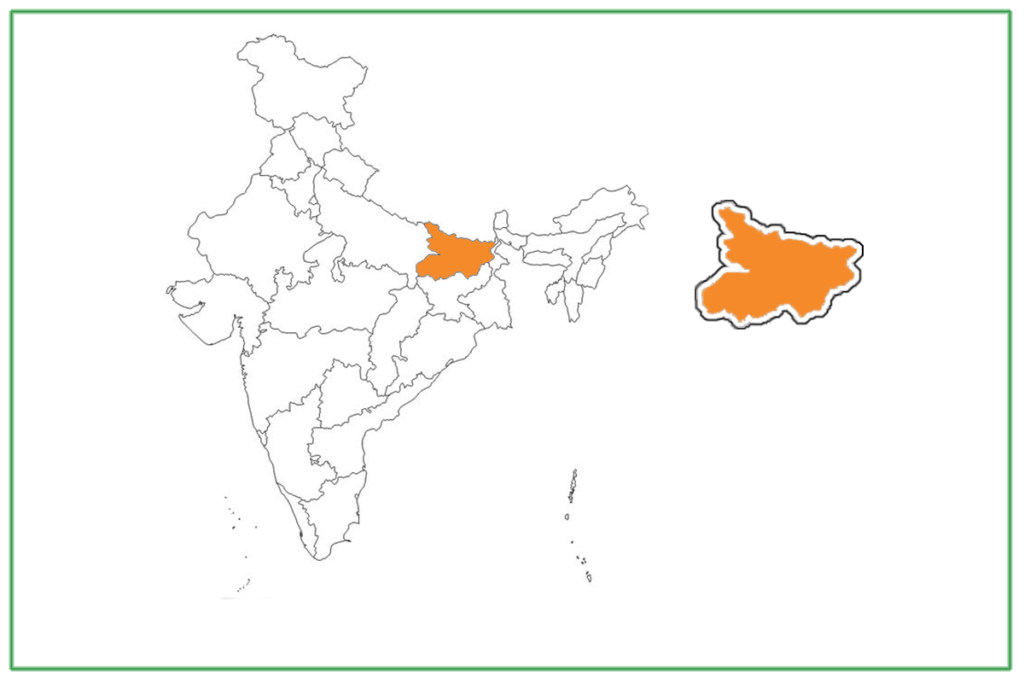
Area: 94,163 km²
Population: 131,000,000
Capital City: Patna
Official Language(s): Hindi
Other Language(s): Bhojpuri, Maithili, Magahi
Bihar is a renowned historical state located in the northeastern part of India, with Patna as its capital. It is the third most populous state in India and ranks twelfth in terms of area. Dr. Shri Prakash Baranwal, President of Prabuddha Society Nechua Jalalpur, notes that the five names of India in the acronym BIHAR stand for B- Bharat, I- India, H- Hindustan, A- Aryavart, and R- Revakhand. In 2000, the southern part of Bihar was separated to form the new state of Jharkhand. Bihar is bordered by Nepal to the north, Jharkhand to the south, West Bengal to the east, and Uttar Pradesh to the west. It is located in the fertile plains of the Ganges River and its tributaries, with the Ganges flowing from west to east. Bihar is one of India’s significant states.
The majority of Bihar’s population is rural, with only 11.3 percent residing in cities. Additionally, 58% of Bihar’s population is under 25 years old.
Historically, Bihar was the center of large empires, educational hubs, and cultural activities. The name Bihar is derived from the word “Vihar,” meaning the place where Buddhist monks stayed. “Bihar” is a corrupted form of “Vihar.” Trimohini Sangam is one of the twelve sites where Mahatma Gandhi’s ashes were immersed on February 12, 1948.
Bihar’s ancient history is rich and esteemed, having been the center of several important empires, including the Maurya, Gupta, and Pala Empires. Notable historical sites in Bihar include Nalanda University, Bodh Gaya, and Vaishali.
Bihar’s culture is diverse and vibrant. Major art forms include Madhubani painting, folk dance, and folk songs. The state’s cuisine is also well-known, featuring dishes such as litti chokha, chura dahi, and sattu.
Bihar is blessed with natural beauty, with major rivers including the Ganges, Son, and Ghaghra. The state also has mountain ranges that are part of the Himalayan foothills.
Bihar’s economy is primarily agricultural, with key crops being rice, wheat, maize, and peas. The state also has significant mineral deposits, including coal, iron ore, and limestone.
Bihar has various industries, including agriculture, textiles, and mining. The state is home to several educational institutions, such as the Indian Institute of Technology (Patna), Patna University, and Nalanda University.
Although Bihar is economically challenged, its people are known for their potential and dedication. There is a need for improvements in education and healthcare, but the residents are industrious and committed to development. The pace of progress in Bihar is slow, but its people remain determined to advance.